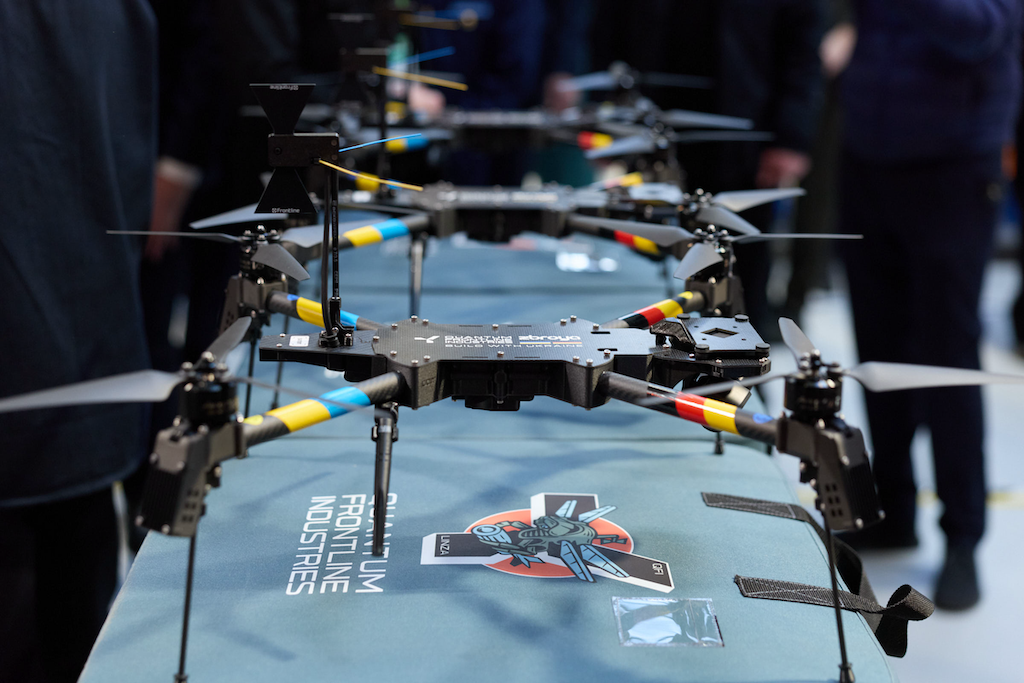
President Zelenskyy received the first Linza 3.0 manufactured at the new German-Ukrainian joint venture, Quantum Frontline Industries, signalling a new chapter in European defence-tech collaboration and the industrial scaling of AI-enabled military drones.
On the eve of the Munich Security Conference, Ukrainian President Volodymyr Zelenskyy did not attend a diplomatic briefing. He walked the floor of a production facility — one that had been standing for barely two months. There, he received the first Linza 3.0 drone to roll off the line at Quantum Frontline Industries (QFI), a German-Ukrainian joint venture that is quickly becoming a symbol of what Europe’s defence-industrial base can achieve when urgency replaces bureaucracy.
“Today, I received the first jointly manufactured combat drone,” Zelenskyy told employees and press gathered at the facility. “This is modern Ukrainian technology — battle-tested and equipped with artificial intelligence. It will carry out strikes, conduct reconnaissance, and protect our soldiers. And this year alone, 10,000 drones produced here will be delivered to Ukraine.”
President Zelenskyy received the first Linza 3.0 manufactured at the new German-Ukrainian joint venture
German Defence Minister Boris Pistorius, who acted as patron for the handover, described the venture as a model for future cooperation:
“We learn from successes achieved on the battlefield and benefit from spillover effects in innovations that are exploited.” The speed of execution clearly impressed him — QFI went from announcement to operational production line in just two months.
The Drone Behind the Headlines
The Linza 3.0 at the centre of this event is not a prototype or a concept. It is the third-generation evolution of a drone already deployed across more than 60 units of the Ukrainian Armed Forces, developed by Frontline Robotics — a Ukrainian defence tech company founded in August 2023 by four Ukrainians with a decade of frontline experience behind them.
On paper, the specifications mark a significant generational leap. The Linza 3.0 carries up to 4 kg of payload — double the 2 kg of its predecessor — over a range of 15 km, up from 10 km, with a maximum flight time of 60 minutes. Its 12-inch frame houses an AI-enabled visual-inertial navigation module developed entirely in-house, available in both daylight and thermal night configurations. The day version features a gyro-stabilized camera at 1280×720 resolution with 6× digital zoom; the night version runs a 640×512 thermal imager at 30 Hz.
But the more important story is in what drove those improvements: direct feedback from the battlefield. Every iteration of Linza has been shaped by the soldiers using it, in active combat conditions. “Our goal is to continuously improve our robotic systems based on the real needs of soldiers on the battlefield,” says Yevhen Tretiak, CEO of Frontline Robotics.
Built for War, Not the Consumer Market
The Linza is frequently compared to DJI’s Mavic series — a comparison Frontline Robotics’ CTO Pavlo Kosolapkin is keen to reframe.
“In the media, Linza is often referred to as a ‘Ukrainian Mavic.’ The comparison is understandable, but not entirely accurate,” he says. “Unlike commercial quadcopters, we designed this drone specifically for military tasks. From day one, we focused on control and video transmission as the most critical elements for battlefield solutions. Only then did we build the airframe.”
That distinction matters enormously in electronic warfare environments. The Linza 3.0 integrates a dual-band encrypted control communication system with frequency hopping — purpose-built to resist the jamming and signal disruption that has become a defining feature of the conflict in Ukraine. Its one-way digital video transmission system is similarly hardened against EW interference. These are not features retrofitted from a consumer product; they are design requirements from the outset.
The integrated optical navigation system also lowers the operational barrier considerably. Linza 3.0 can hover stably over a target at up to 200 metres altitude, map its completed flight path, and assist with precision landing — capabilities that reduce the training burden on frontline operators and improve reliability in complex urban or terrain-heavy environments.
Linza 3.0 drone
The platform’s design philosophy prioritises versatility across the full tactical spectrum: strike missions, logistics drops, reconnaissance, relay carrier operations, minelaying, and even drone evacuation. It ships ready to deploy, and Frontline Robotics backs it with 24/7 technical support and a warranty covering up to 80 flights under standard operating conditions.
A Joint Venture Built at ‘Lightspeed’
The production context is as significant as the product itself. Quantum Frontline Industries — a joint venture between Quantum Systems, a Munich-based high-tech unmanned systems company, and Frontline Robotics — was announced in December 2025 and reached early-stage production in under two months. It is the first European facility of its kind: a fully automated, industrial-scale foreign production line for drones destined exclusively for the Ukrainian Armed Forces, with 100% of output directed to Ukraine’s Ministry of Defence.
“Quantum Frontline Industries has started production in just two months after the announcement,” said Matthias Lehna, Managing Director of QFI. “QFI is the first of its kind, but will not be the last. We are proud to be a flagship company for Ukrainian-German industrial cooperation.” The facility is already targeting 10,000 units in its first year, with plans to further automate and scale its supply to broader European customers.
Mykyta Rozhkov, Chief BD Officer of Frontline Robotics, framed the achievement in terms of the engineering effort behind it: “This first QFI-produced Linza 3.0 represents months of dedication from Ukrainian engineers and our international partners. It was created from frontline experience and is already helping Ukrainian forces operate more effectively.”
A Blueprint for European Defence Tech?
The Linza 3.0 story raises a broader question about how European defence technology is built—and where. Ukraine has become, by necessity, one of the world’s most intensive testing grounds for autonomous and unmanned systems. The speed of iteration, driven by real operational feedback, has produced a generation of Ukrainian companies whose products are, arguably, more field-validated than anything developed in a conventional Western procurement cycle.
Frontline Robotics is a case in point. Founded in August 2023 — well into the full-scale conflict — its founders had already spent nearly a decade delivering solutions for the Ukrainian Armed Forces. Today, the company develops a portfolio spanning aerial drones (Linza, Zoom reconnaissance), ground robots, and the Buria robotic turret, all oriented around a single principle: replacing humans with robots in the most dangerous frontline tasks.
The Munich handover, facilitated by Ukraine’s Council of Defence Industry, was as much a signal to European defence ministries as it was a product launch.
Tretiak put it plainly: “Modern warfare proves that the decisive role belongs to systems that are reliable, accessible, and scalable. Our next objective is to scale production without compromising quality.”
For a continent rethinking its defence posture, Linza 3.0’s rapid journey from battlefield feedback to German factory floor may be the model worth studying.


0 comments