EU Climate Policy is Deciding the Future of Clean Tech survival
Katie Tincello breaks down what the EU’s latest climate policy shake-up means for clean tech funding.
The climate crisis is literally heating up. The EU is committed to reducing emissions and dependence on fossil fuels, and climate tech startups will make this possible.
Europe’s climate policies, especially the EU Emissions Trading System (ETS) proposal, will shape the next decade of the EU’s carbon market. They are arguably the biggest lever pushing state capital towards climate and sustainability startups. Yet the revised proposal, published in July, appears to ease pressure on the same incumbents that climate tech is supposed to displace.
The Climate Commissioner Wopke Hoekstra commented in his speech that the review would turn the ETS into a “genuine engine for innovation and investment”, but the ETS and other policy decisions in the coming months may threaten that reality.
The Trigger for New Policies
EU climate policy is primarily shaped by Regulation (EU) 2021/1119, which outlines two leading commitments: climate neutrality across the EU by 2050, and a net greenhouse gas reduction of at least 55% by 2030 versus 1990 levels. In February, the European Parliament agreed a new target of a 90% cut in net emissions by 2040, extending the timeline by a decade. The existing policies were written for the 2030 deadline, so Brussels must build a new phase to hit the 2040 goal, triggering the current wave of policy reviews and new proposals.
On 17 July, the European Commission published its ETS proposal package, outlining new heat and fuel benchmarks, an Electrification Action Plan, and revised ETS directives. The ETS is the world’s first carbon market, launched in 2005 as a policy system designed to support net-zero initiatives and generate revenue to finance the clean energy transition.
Theoretically, it should pull more capital toward climate tech. Yet, EU carbon prices jumped roughly €7 following the ETS publication, hitting €86 by July 22. This is the converse of what we would expect from a proposal intended to make pollution more expensive, not more profitable. It raises concerns for those downstream, whose future is closely linked to how quickly industry giants adopt clean energy technologies.
The Proposal: changes and impact
The ETS proposal includes several key decisions with significant implications for the industrial decarbonisation market.
CBAM allowances
What it is
The Carbon Border Adjustment Mechanism (CBAM) requires importers of carbon-intensive goods, including steel, cement, aluminium, fertiliser, electricity, and hydrogen, to pay fees for the embedded carbon in these products entering the EU. The policy came into force on 1 January 2026 and aims to stop companies dodging carbon import costs. In the July proposal, the Commission extended several free allocation phase-out dates for CBAM-covered sectors.
Why it matters
Free allocations were due to start being reduced this year and fully removed by 2034, and the deadline extensions create an immediate €6 billion allocation boost for heavy industry. It comes with a caveat: companies still receiving the allowances must outline how they will invest in decarbonising their EU operations.
But an outline is not an action, and the decision effectively extends the window in which steel, cement, or fertilisers can keep emitting cheaply, and thereby weaken the impetus for these industries to buy into a startup’s decarbonisation technology.
Electrification Action Plan
What it is
Under the EU Clean Industrial Deal, the Electrification Action Plan sets an electrification target of 46% of the EU’s energy consumption by 2040, up from 23% today. To reach the target, the plan is pushing for greater electric vehicle adoption and using heat pumps for buildings.
Additionally, the post-2030 ETS emissions cap will now fall by 3.7% between 2031 and 2035, and then 1.7% from 2036 to 2040. Similar to the CBAM, free allowances will be tied to whether a company is investing in decarbonisation processes.
Why it matters
The Electrification Action Plan seeks to redesign the carbon market to support the electrification push by providing guaranteed, large-scale electrification demand. With clear demand requirements, industries can make necessary infrastructure adaptations in time, before rising carbon prices make them a necessity. Good news for clean tech and electrification startups.
Industrial Decarbonisation Bank (IDB)
What it is
The IDB is a proposed €100 billion initiative aimed solely at financing the industrial green transition. It is funded by four sources, including the Innovation Fund, the EU’s flagship cleantech grant scheme for carbon-focused startups. The IDB allocates funding through carbon contracts for difference (CCfDs), which guarantee a company the difference between the carbon price it needs to make a low-carbon project viable and the market carbon price.
Why it matters
Following its pilot programme in October 2025 on industrial heat decarbonisation, the IDB is now moving towards wider execution. Yet the estimated cost of decarbonising Europe’s four largest energy-intensive industries is €500 billion, meaning the initial funding covers only a fraction of what heavy industry alone needs. Additionally, the funding is struggling to make it out of the door.
Only 16 of 208 agreed Innovation Fund projects were operational as of mid-2025, raising questions as to whether the IDB can support projects all the way through to construction and operation.
So what happened to the funding?
The ETS proposal is by no means fixed, with Parliament and Council still to form their positions. But even before those decisions are made there is a clear underlying problem. The European Commission is, theoretically, sitting on over €100 billion of funding, some of which has been allocated but hasn’t yet materialised.
The Innovation Fund has awarded €7.1 billion in grant agreements since 2021, but only 5% has been paid out. Part of the reason is a “bankability problem”, where banks providing the funds assess a project’s credit risk as too high.
Technology startups are particularly vulnerable for the same reasons that underpin all of venture law: a new product, thin equity backing, and an as-of-yet unproven market success. Consequently, of the 208 grants signed, only 45 reached financial close and just 16 are currently operational.
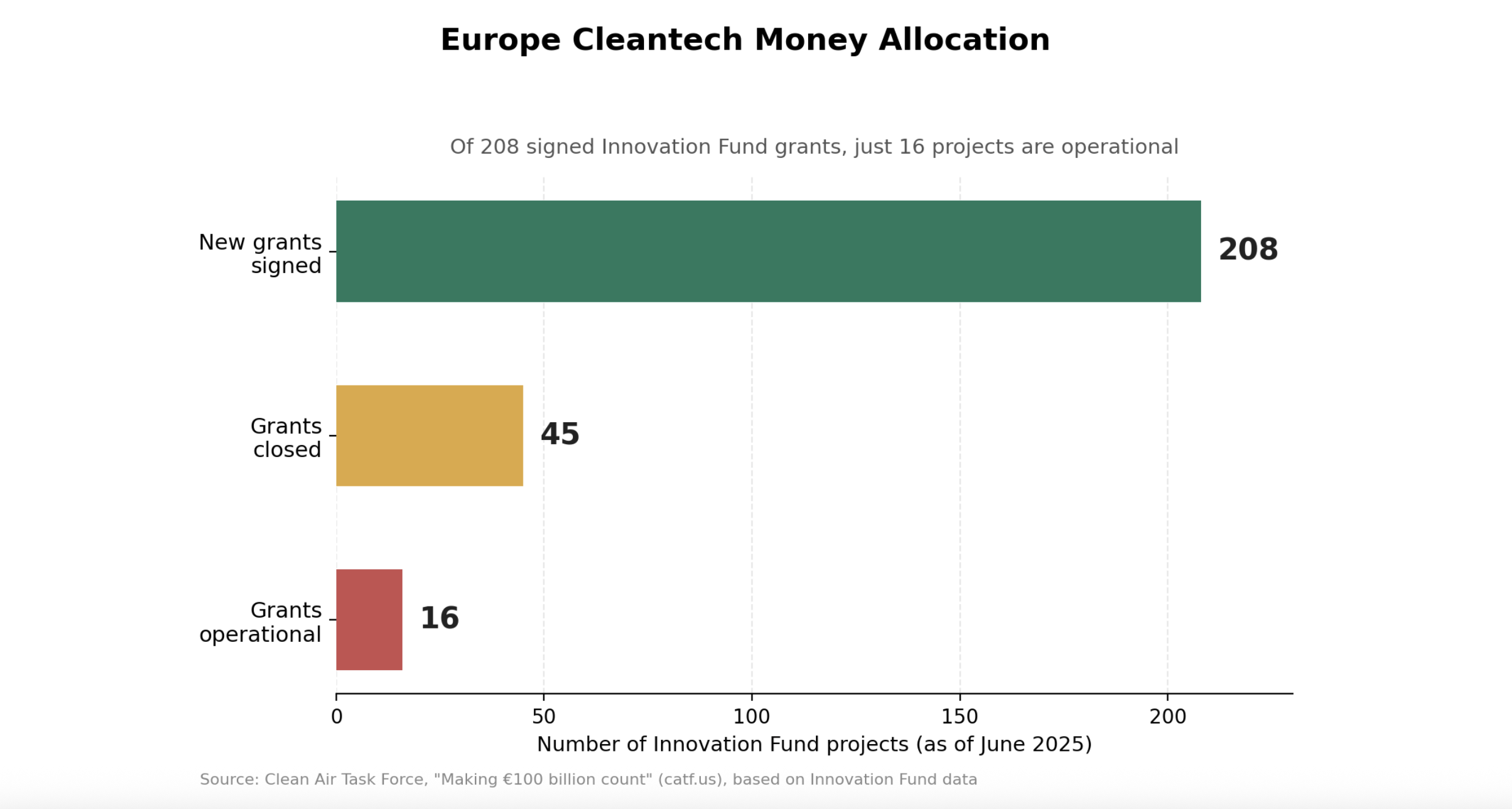
The Commission signed a further 54 new grant agreements in March 2026, worth €2.7 billion, but with no indication of when or how those projects will start.
Even if the funding reaches companies, we still face an overwhelming shortfall in EU green transition investment. Only around 20% of European climate tech funds focus on growth-stage financing. Private venture capital may fill this gap in other industries, but it is also declining in climate tech.
EU cleantech venture capital investment fell to €1.3 billion in Q1 2026, down from a 2024 average of €2.2 billion, with later-stage deals taking the biggest hit.
The IDB is aiming to help address the problem by restructuring how funding flows. The CCfD structures help to de-risk projects at the stage where they are getting stuck by incentivising industries to turn to low-carbon solutions. But the decisions made in the next few months could well undermine this if the policies that are pushing industry to adopt clean tech alternatives are diluted.
What next?
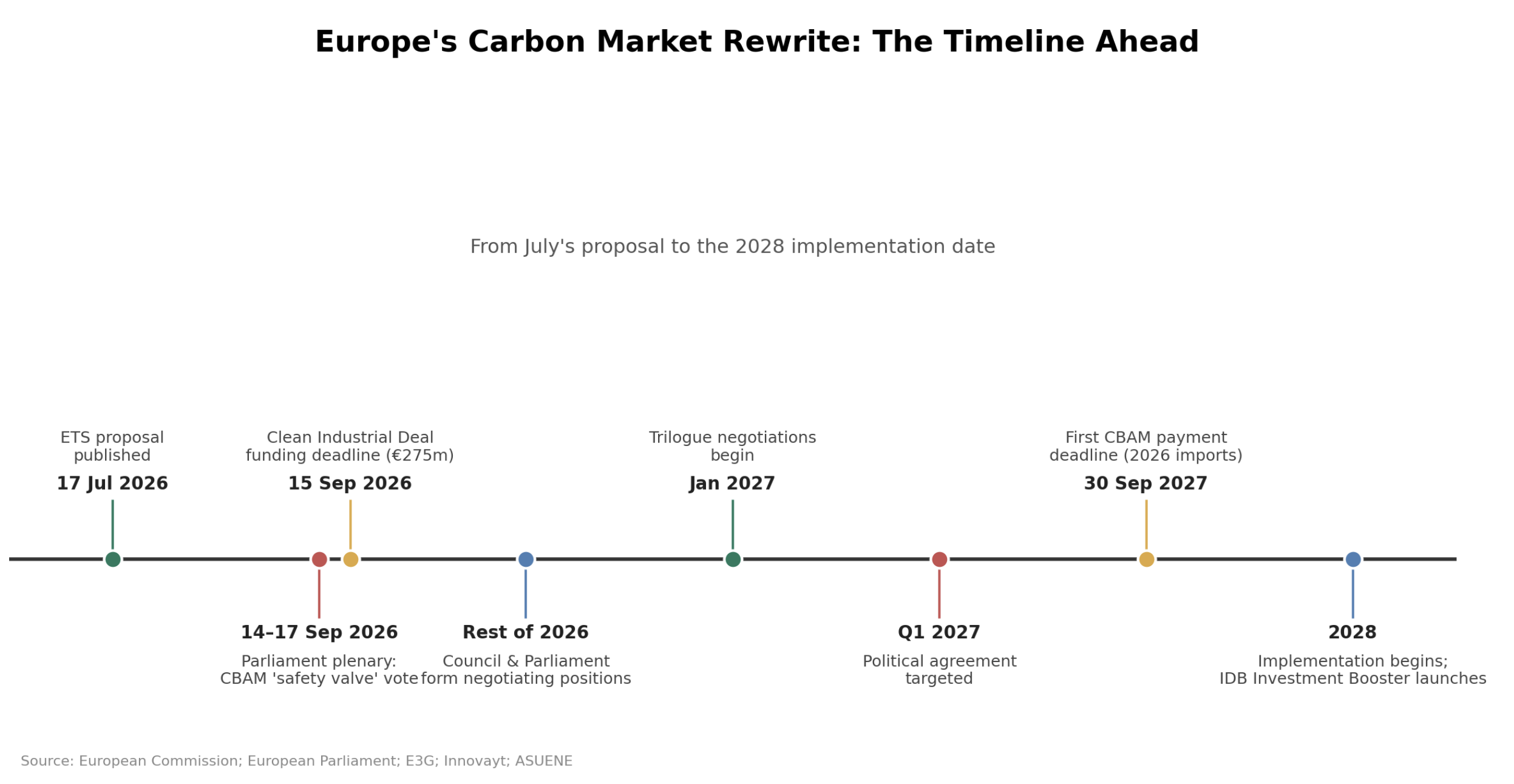
Parliament is set to start its discussions on the ETS proposal imminently, with a political agreement on the directives scheduled for Q1 2027. September will also see two other decisions that hold considerable financial implications for climate tech.
September 15 is the deadline for two Horizon Europe Industrial Deal calls, part of a €275 million funding opportunity for industrial carbonisation pilots in carbon-capture, electrification, and clean energy.
The European Parliament’s plenary session to discuss CBAM’s “crisis safety valve” position is scheduled for the same week the grant applications are due.
The decision will determine whether the carbon-pricing mechanism that underpins the push for industrial carbonisation will survive political pressure.
The European Environmental Bureau has been vocal in it’s criticism that the ETS proposal rewarded polluters at the expense of businesses betting on a fossil-free production model.
Cleantech for Europe, the Brussels body representing European climate tech startups, scaleups and investors, also argued that weakening the ETS would hit early startups already building decarbonisation solutions the hardest. Delayed phase-out schedules significantly undermine the push for large industrial players to adopt clean energy solutions, and startups piloting these technologies may struggle to survive in the market.
The ETS proposal package is the clearest indicator of what the next decade of fuel, energy, and sustainability policies will look like, and right now, climate tech is not the player positioned to come out on top.
Katie Tincello is a tech writer and journalist covering technology, climate, startups, and venture capital. She began her career at LatamList, the leading tech news hub in Latin America, before joining Newsweek, where she reports on climate and sustainability alongside her continued work with venture capital firms, startups, and enterprises across Europe and the U.S.
0 comments