Anton Vedeshin on Snoika: From Vespia Exit to AI Visibility
Anton Vedeshin has spent most of his career on software nobody outside a niche ever sees — fleet management for 3D printers, KYB and AML compliance engines, cyber-physical systems built for governments. That chapter closed in February 2026, when Veriff acquired Vespia, the business-verification platform he co-founded.
He didn’t take much of a break. Snoika, his new company, is an AI visibility execution platform that helps brands become visible, cited and recommended across ChatGPT, Gemini, Perplexity, Google AI Overviews and traditional search.
I caught up with Anton a couple of days after TechBBQ 2026 in Copenhagen, where the Snoika stand had a steady stream of people through it for two days. We talked about the event, why he thinks many ‘AI SEO’ providers have only changed the label, and what it’s like running an Estonia-registered company while he’s mostly in Europe but keeps turning up in San Francisco and Copenhagen.
The TechBBQ pitch
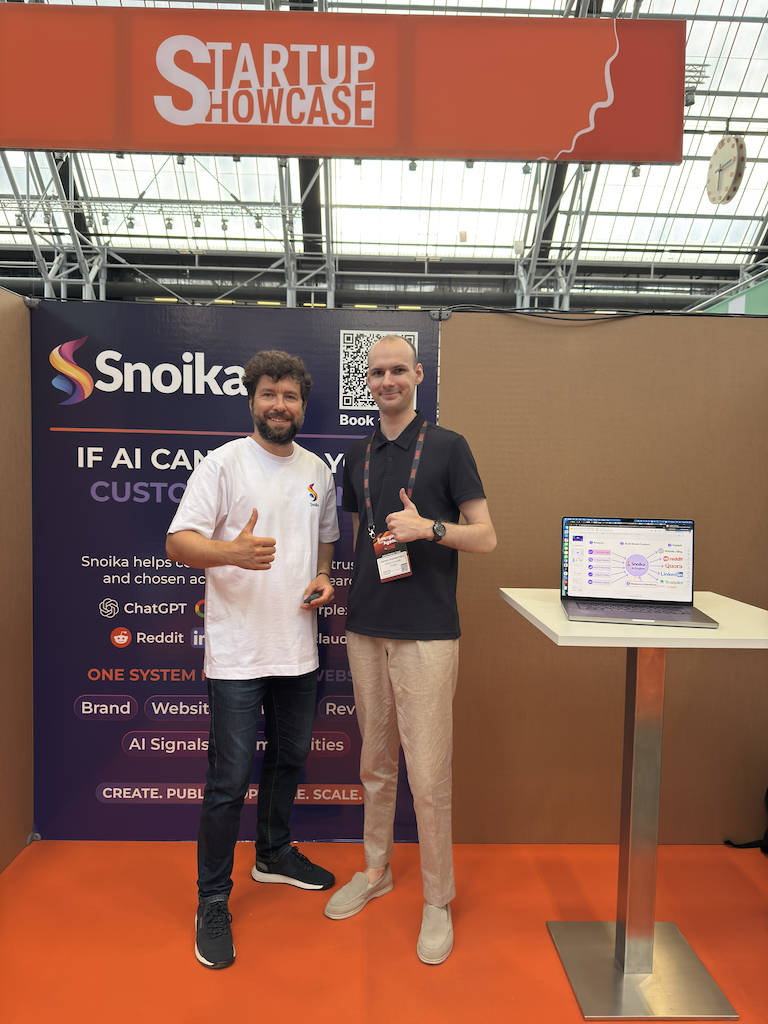
He’d posted on LinkedIn that the stand was one of the places everyone wanted to go, so I asked what he was actually telling people who stopped by.
“The event was great — a lot of people, a lot of interest,” he says. “Snoika helps brands to be visible in AI and on search engines, through high-quality content creation for the website and other channels — Reddit, social media, LinkedIn.”
It’s a pitch he clearly believes personally, not just commercially. He has a PhD in cloud computing, started coding at eleven, and set up his first IT company at 21, while he was still at university.
“At that time I was creating great products, but the market didn’t see them. As a technical person, that was really hard for me.”
Over the following decade, he taught himself deep SEO on his own companies’ websites — “how to help others see businesses” — and that experience became the foundation for Snoika’s AI visibility platform and managed execution layer.
“My own struggle became the mission of Snoika.”
I asked what, if anything, surprised him this year, compared with earlier TechBBQs.
“The interest is growing,” he says. “A year or two ago, at different conferences, people didn’t really get it. Now more people understand they need to be visible. That’s pretty good.” But — and this is a point he came back to more than once — most people still don’t know where to start, or who to trust. “So many people don’t want to try something, because they’ve had experience with it before that didn’t work.”
Part of that, in his view, is the market’s own doing.
“There are so many companies who used to be marketing agencies doing SEO. Now they’ve just rebranded — changed the website to say, okay, now we do GEO, AI optimisation. But underneath, technically, nothing really changed. They still do it manually, or semi-manually,” he argues that at any real scale this has to be automated — Snoika keeps a human review layer on top, he says, but the raw tracking of keywords and numbers “is just impossible” to do by hand any more.
“It’s like controlling a drone without the microcontroller — you’re never going to fly those small motors with just your hands.”
What actually happens when you sign up
I asked him to walk me through the workflow for a new client, start to finish, and how he measures results.
“The first step is onboarding. We collect information about the customer — their business, their ideal customer profile, market learnings, existing website content, sales brochures, that kind of thing.”
From there, Snoika configures a client-specific AI model and workflow around the company’s ICP, market context and tone of voice, with the implementation varying by customer size and needs — more fully tailored for larger brands, more of an agentic workflow for smaller ones.
Next comes what he calls a strategic content plan — which keywords and niches to target, in what order, and at what volume. Results are measured across organic search, AI visibility and brand mentions, conversions and booked meetings, tracked through real-time and one-off reporting.
He mentions enterprise clients in fashion, automotive and manufacturing — no names, NDAs — as evidence the approach holds up at that scale. He points to company-reported figures: 3DPrinterOS saw an 87% increase in LLM brand mentions and a 185% increase in organic users, generating 3–4 qualified inbound leads a day after 180 days; 1StopVAT’s ChatGPT visibility rose from 2.7% to 28.3% in 16 weeks.
“Those companies did their own selection on the market. They checked demos, checked what other companies were doing, and they chose us. Because we go really deeply in terms of analytics, which gives real insight into what kind of content you need to produce.”
I asked who should actually be paying attention to this — and whether his sense of the ideal customer had shifted.
His answer wasn’t just “everyone.”
“We like to work with companies who are there to stay — solid, established companies.”
That doesn’t mean startups are excluded — the strongest fit, he says, is established companies alongside deep-tech or genuinely niche startups with real customer demand and enough market substance to build on.
“Right now there’s a lot of noise, especially AI noise — lots of different AI apps or tools, and it’s pretty hard to market them, because bigger players are putting a lot of money into visibility. It’s hard for these guys to outperform that.”
He compares it to crypto marketing a few years back, when smaller projects were competing against companies “throwing millions at it.”
His take: if you’re deep-tech, or genuinely niche, or simply an established business with real customers rather than something “created by vibe-coding in one evening,” it’s much easier to get good results — and those are the founders he thinks should be moving now.
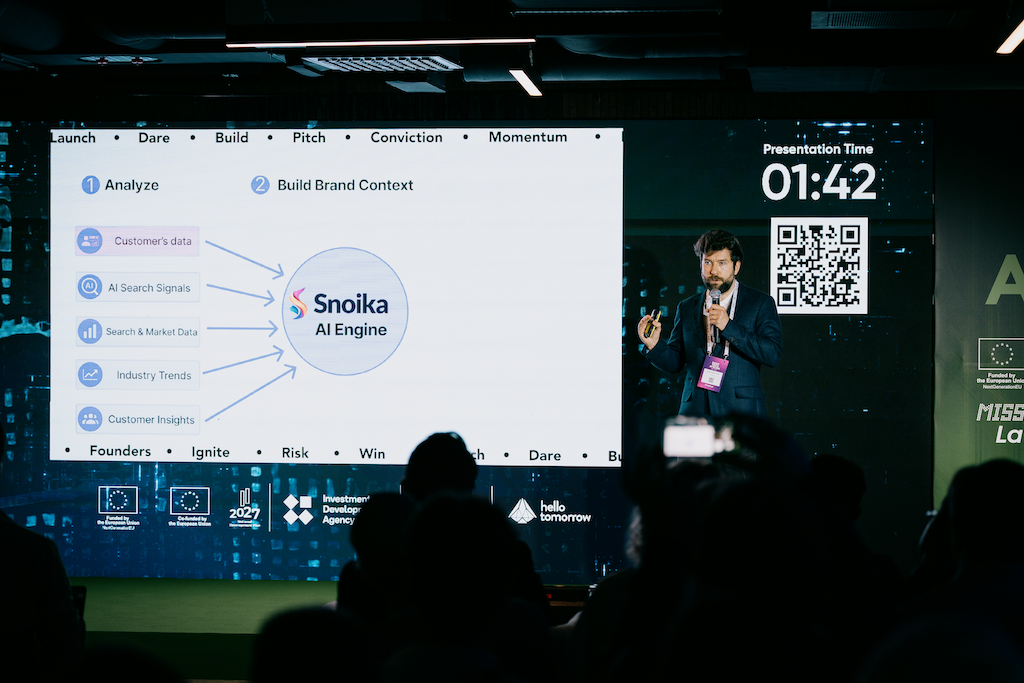
The crowded market, and whether paid AI placement changes anything.
GEO tools are everywhere at the moment — Profound, Peec, Ahrefs Brand Radar, and plenty of smaller entrants. I put it to him directly: what stops this from repeating an earlier hype cycle, where the label changes faster than the substance behind it?
His answer looped back to the same point he’d already made about agencies rebranding without changing their process.
End-to-end execution — analysis, brand context, content creation, multi-channel publishing and measurement — is, in his view, what separates something durable from a relabelled service.
He’s also written publicly about the emergence of paid placement around AI answers. If AI search ends up monetising the way Google did, doesn’t that close the organic window Snoika is selling into?
“I don’t think it’s closing,” he says. “Before, when we spoke about SEO and Google Ads, it was the same dynamics. Some people invested in ads and got traffic, got customers. Some people did classical SEO and also got pretty good results. Ads are usually faster, but they’re also costly, and there’s no investment into the future — what we do is really fundamental.”
The website, he argues, is the one thing a founder actually controls.
“You never know when Reddit will get acquired — I don’t know — by Elon Musk, or any other player, and the rules change. Not necessarily in a bad way, but things change, and it’s out of your control. The website is always under your control.”
He offers a personal data point: websites he built fourteen years ago, untouched for the last eight, still bring in leads — a couple of form submissions a month, in a B2B context.
“For inbound strategy, the ROI is stretched into the future. It’s an investment. There’s no way to pay a company and say ‘I want to be number one in Google or in a GPT answer’ — technically it’s just not possible. You have to earn it over time. But over a longer horizon it pays off much better than ads. The moment you stop paying for ads, that paid traffic typically stops.”
Before we moved on, I asked if there was anything about the product itself he wanted on the record that I hadn’t asked about.
“The most important part is we’re at the execution layer for AI visibility. A lot of companies in the market do analysis — they show you the issues, which is useful; we do that too. But we go much further. We fine-tune the models, we create the actual content pieces for our customers, and that’s what pushes visibility up. That’s what makes us different. We do it across many channels, so you don’t need three, four, five providers — you get it all from one place.”
Estonia on paper, Europe and San Francisco in practice
Snoika is registered in Estonia. Anton says he’s mostly in Europe these days, though his LinkedIn posts keep turning up from San Francisco and Copenhagen. I asked what building in a European ecosystem actually means, in practice, for someone who’s exited companies on both sides of the Atlantic.
“The US ecosystem is amazing — it has huge magnitude. But it might be harder to execute there. It really depends on personal matters. I’d say in the US it used to be easier to get initial investment just for the idea, and push it forward. Europe is more programmatic—most investors here look at the numbers, MRR, that kind of thing. Rarely do they invest just in the idea.”
He’s not arguing one is better.
“Both approaches have their pluses and minuses — they’re just different. Founders need to try both, go to Silicon Valley or the US, stay there for some time, and see how it works for them. No single turnkey solution works for everyone. I experienced both, and I got something amazing out of both worlds.”
Why be a founder at all
I asked the more personal question — why become a founder, and whether a moment or a person pushed him that way.
“I’ve been in corporate too, and it’s just a different experience,” he says. “Being a founder is frequently not fun — there’s a lot of struggle, there are so many films about it. It’s more about what people like for themselves. In enterprise, you have a fixed salary, you go to the office, you enjoy colleagues, coffee, meetings. Startups are completely different.”
The instinct goes back further than his first company, he says — to games in the yard as a kid, “building some sort of company,” with stickers standing in for currency.
“It was fun because you observed the whole process. Working for a large enterprise, a lot of the time you feel like you’re in a bubble — you don’t even know how much tax the company’s paying, what that takes.
You’re a small gear in the whole thing. In a startup you’re more hands-on — today you’re the marketing person, tomorrow you’re the CEO, the day after you’re a developer or a tester.
You do everything, and you get a deeper experience. Of course, it’s not for everyone.”
Even the exit didn’t really slow him down.
“The next day, I just started thinking — okay, what’s the next venture I’m going to chase?”
Snoika has a co-founder, Jevgenia Pogadajeva — the two met at university, on the same programme. Anton’s advice to anyone looking for a co-founder is fairly blunt: find somewhere you can watch someone actually work.
“Maybe a hackathon is pretty good, because you see what people can do in a short period of time — how they deliver. I’ve worked with people who’d just disappear — ‘I’m going to sleep, you carry on’ — and you need people who’ll say, come on, we need to build this. A place where you see people in real action.”
The closing note
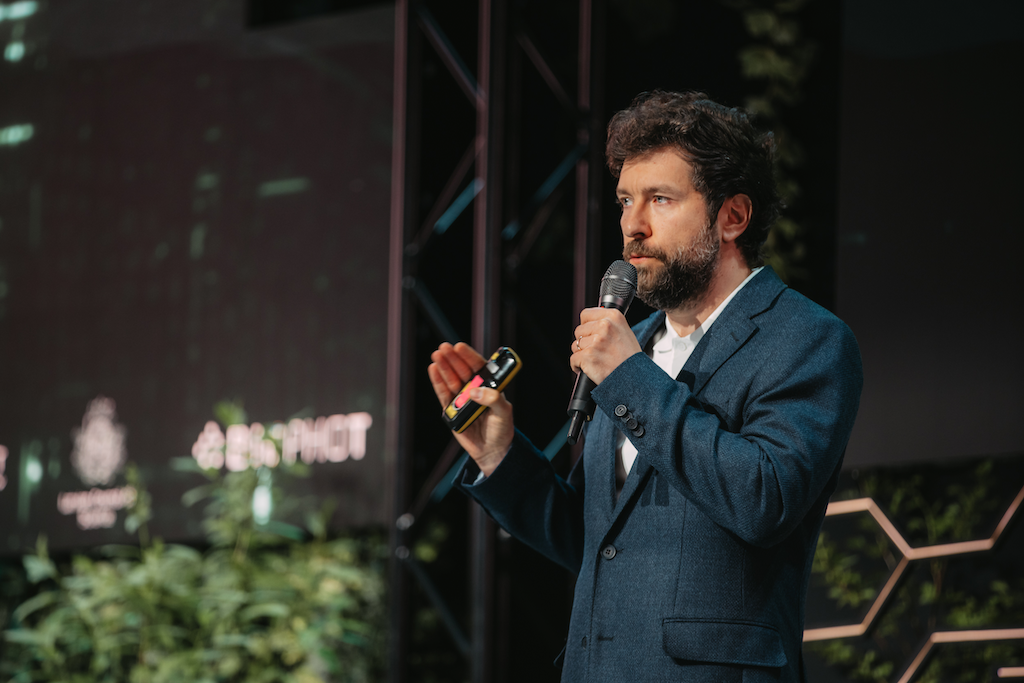
I asked, as I usually do, if there was anything he wanted to leave for readers that I hadn’t asked about.
“There are so many great people, and startups, and products on the market, which are frequently invisible,” he says. “Even talking to founders at TechBBQ, other conferences, I find out they’ve been executing for one, two years, and somehow I couldn’t find them. So this visibility question is really important nowadays — you might be building something people want to buy, want to use, and they don’t know you exist. I’m glad I’m doing Snoika and fixing this. Maybe not as fast as I’d like, but I think what we do is genuinely important. We really want to help other people get known.”
Anton Vedeshin is CEO and the founder of Snoika, an AI visibility execution platform, and co-founder and former CTO of Vespia, acquired by Veriff in February 2026.
This article was drafted with AI assistance based on a live interview conducted by startupreporter.eu, then edited for length and clarity. by the startupreporter.eu team.
0 comments