Opally Wants AI to Give Hotel Receptionists Their Time Back, Not Take Their Jobs
A 23-year-old solo founder built the first version of his hotel AI assistant in nine days, from an airport terminal, after watching a hotel reception desk drown in emails. A year later, it’s running in more than 50 hotels across six countries.
Most founding stories get told backwards — the milestones first, the mess after. Gustav Søgård, founder and CEO of Copenhagen-based Opally, pushed back on that instinct almost immediately when I sat down with him for this piece.
“A lot of times it’s about the headlines — we just raised this money, we’re going after this new market,” he told StartupReporter.eu. “Instead of going a few steps back and talking about what led you there. Every success is just experimentation until you get to the success. There’s a lot of trial and error.”
So here’s the version with the trial and error left in.
The problem, seen from behind a hotel desk
Opally’s origin story isn’t abstract market research — it traces back to a summer Gustav spent helping out at a hotel on Bornholm, watching the operational reality up close: guests checking in at 3pm, checking out at 11am, staff moving luggage while somehow also supposed to be answering email.
“They got 50 emails a day inbound that they had to answer,” he said. “It could be something simple — ‘I’m checking in next week, can I bring my pets?’ — but reception also had to check guests in and out, help with baggage, and go back to a computer and type everything manually.”
He’d been watching AI coding tools like Cursor reshape how software gets built, and had a simple thought: could something similar work for email — reading a hotel’s inbox and drafting the replies? He connected the tool directly to the hotel’s Outlook inbox. After a few weeks of iteration, it was working well enough that he started wondering if other hotels wanted it too.
“I walked around Copenhagen meeting people I’d never talked to, went into hotel receptions and said: this is my name, this is my company, is this a problem you also have?” he said. By October last year, he had two or three pilot customers testing early email drafts.
From one feature to a full platform, one customer request at a time
What makes Opally’s growth story unusually literal is how closely the product map follows customer asks. “Someone asked, can you do it on the website too? Then can you help us reply on Instagram and Messenger? At some point you’re just covering all the touchpoints for guests,” Gustav said. One hotel wanted images included in email replies — so that became a feature.
“That’s a learning for other entrepreneurs — being so close to the customer, because if you see one hotel with a real problem, there’s probably 50 or 200 others with the exact same one.”
Today Opally works across email, website chat, WhatsApp, Messenger, Instagram, and a voice assistant that can answer reception phone calls — all pulling live information from a hotel’s booking system and property management software rather than generic scripted answers, and drafting responses in more than 100 languages. It’s since added a review-response tool and an “AI Visibility” feature aimed at helping hotels surface correctly when travellers search using AI tools like ChatGPT or Gemini instead of Google.
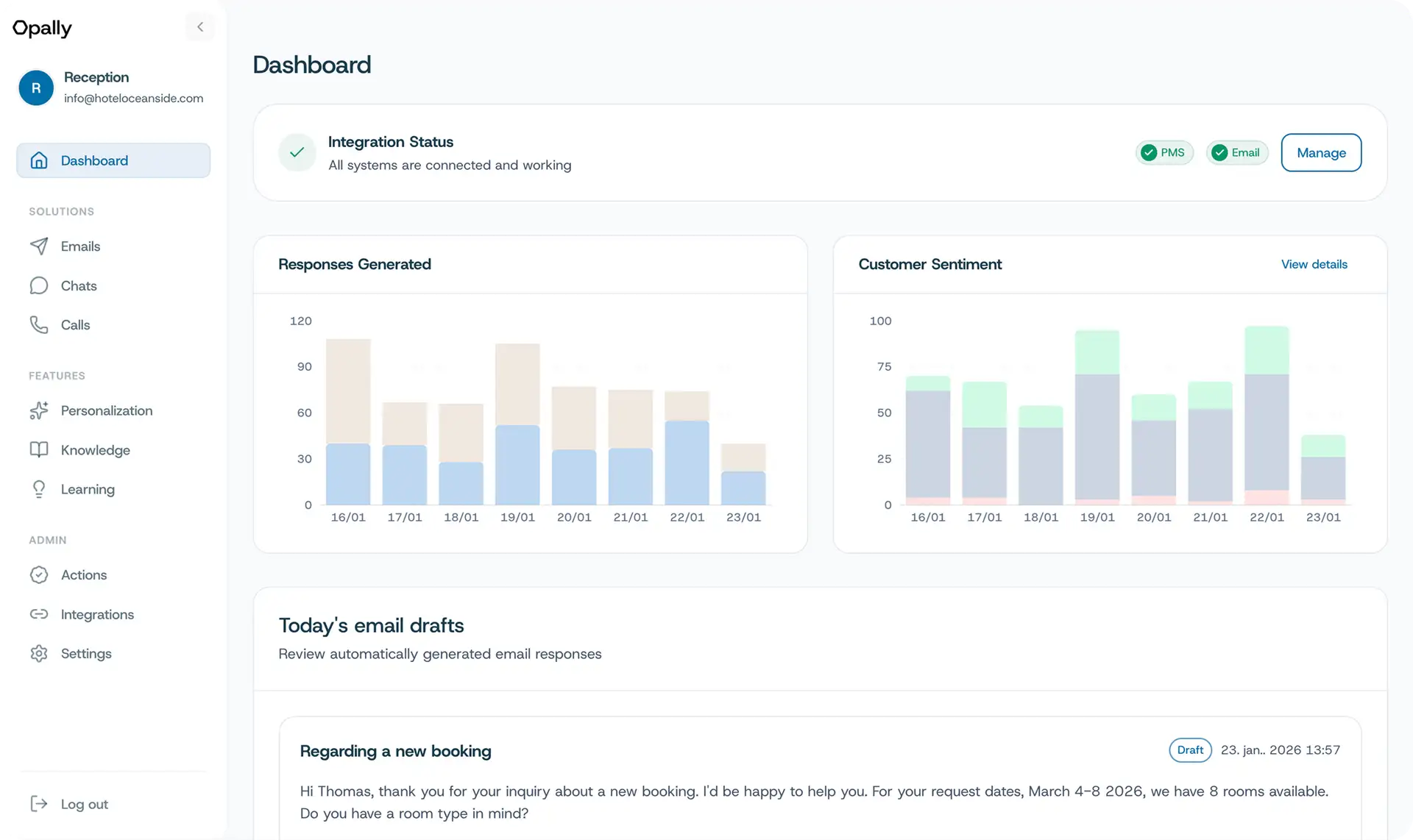
Opally has since worked with brands well beyond the scale of the original Bornholm hotel that inspired it, including a collaboration with the Santorini and Mykonos luxury group Cavo Tagoo — a signal, Gustav has said elsewhere, that the product holds up in a market segment where guest communication is inseparable from brand tone, not just speed.
The framing he keeps returning to, on and off the record: this isn’t about replacing the receptionist. “It’s about giving them time back to what’s most important — hosting,” as he’s put it. Hotels decide what Opally can answer automatically and what goes to their team for review first.
Wedge first, everything else later
Asked what he’d tell a first-time founder about where to start, Gustav didn’t hesitate: don’t try to own the whole market on day one.
“You don’t need to own 100% of the market. It’s so much more about iteration with a small target audience,” he said. “My wedge was email drafts and web chat, because I knew pretty much all hotels get a lot of email and have a website. I used that to get in, get feedback, and build on top once they were happy.”
The same logic shaped how he thinks about speed as a competitive edge in an AI-crowded market. “If we didn’t build features so ferociously, so quickly, we’d leave a lot of opportunity on the table,” he said. “Customers see that iteration speed, and it becomes a reason to choose you as the vendor.”
Fundraising on his own terms
Opally has closed its first funding: an angel round backed by five investors, each bringing direct operating experience rather than acting as a generalist syndicate — People Ventures, the Nordic early-stage VC where Anders Kynde Frederiksen, co-founder of Planday (acquired by Xero in 2021), is General Partner; Lasse Kjær, co-founder of Understory; Christian Markedal, co-founder of DigitalGuest; Jonatan Marc Rasmussen, co-founder of All Gravy; and Bjarke Klinge Staun, angel investor and an early backer of Lovable.
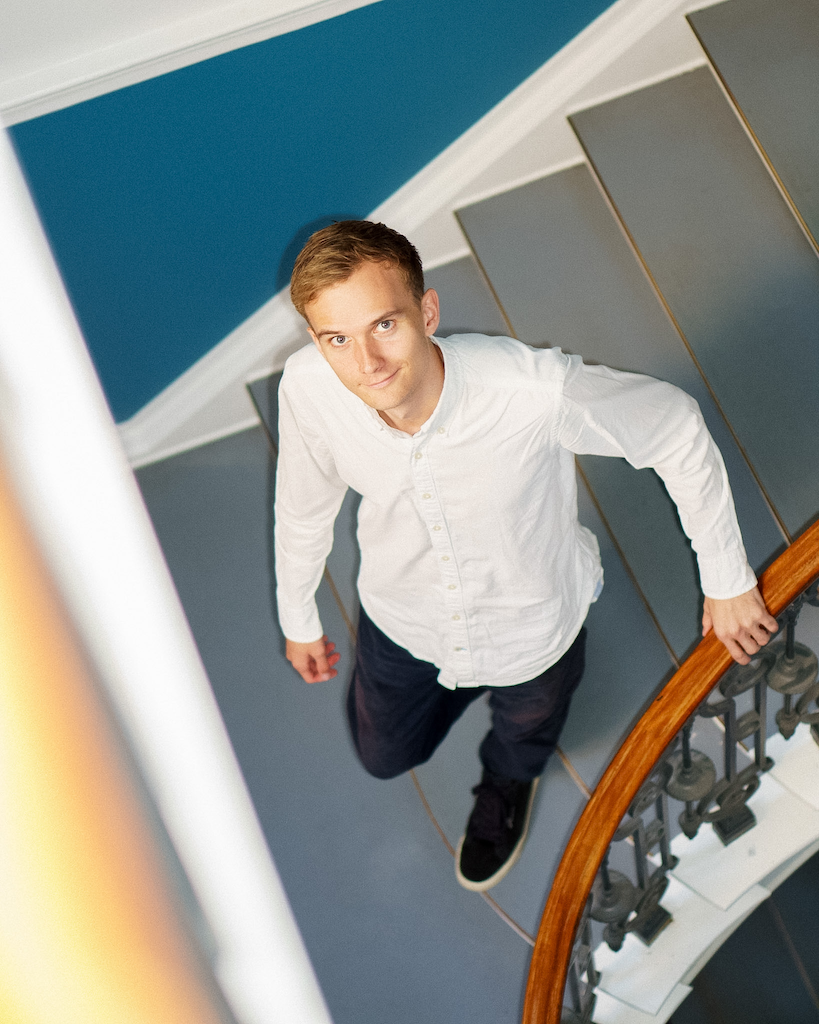
Gustav was deliberate about not rushing that step. “This is my first real tech company, built from the ground up by myself,” he said. “It was very important to have full autonomy — to keep experimenting and figure out what the company is even going to be in 5 or 10 years before pulling the trigger on fundraising. A veteran founder on their third or fourth company might go straight for a massive seed round. For me, I wanted an angel round first — people who’d been in the space before, who could actually help.”
His read on the trade-off is blunt: “Raising a lot of money comes with expectations. Be sure you can set those expectations — which market you’re going after, how you want to build the culture — before you commit to it.”
Building in Copenhagen, staying in Europe
Gustav is candid about what the Danish and Nordic startup scene gives a young founder — and equally candid about the pull toward the US that he sees pulling friends away from it.
“Even though there are a lot of people in the industry, you can get to know a huge number of them fast. Know one or two people and they’re connected to almost everyone,” he said. “News travels quickly too — whenever a company raises or launches something, it spreads fast, even across borders.”
But he’d like to see less headline chasing and more honesty about the process behind the headline. “It’s very easy to sit on a stage and get interviewed when everything’s going great,” he said. “But every success is trial and error — even a serial entrepreneur’s fourth company looks like one long success story from the outside, but the first three weren’t like that. New founders should hear more about what actually led there.”
On where he wants to build: “I have a lot of friends moving to the US, unfortunately. But I’d rather build a big, nice company in Europe. It would be great to build a group of founders here, staying in Europe, building that strong for decades to come.”
What’s next
Opally has grown from roughly a dozen hotel clients late last year to more than 50 properties across six countries in under a year, and Gustav has since brought his brother onto the team to focus on growth.
Looking twelve months out, his ambition is less about a number and more about scope. “Hopefully we’ll look back and see it’s grown more ambitious than just helping hotels answer guests,” he said. “It might spiral into more than an AI assistant — that’s still to be decided.” On growth, he was more concrete: “Up to 200 hotels would be great, and we’ll stay focused on Europe.”
On what sustains a solo founder day to day, his answer wasn’t a wellness routine — it was proximity to people in the same boat. “I’m lucky to sit in an office with like-minded founders. We know how it is to be a founder, and that helps tremendously.”
Opally is hiring, informally for now. “If there’s anyone who wants to start a conversation, please reach out,” Gustav said. “It doesn’t have to be a big commitment right away — but who knows what it can grow into.”
Opally is based in Copenhagen and works with hotels across six European countries. More at opally.com.
Sasha Komarevych conducted this interview for StartupReporter.eu. AI tools helped transcribe, structure, and edit the raw conversation into this Q&A format; the interviewee reviewed and approved the final text before publication.
0 comments