“Most Businesses Aren’t Struggling to Access AI, They’re Struggling to Structure It”: Inna Bondarenko on Building Kalei
Kalei founder Inna Bondarenko spent eighteen years at Deloitte — corporate finance, then Deloitte Ventures, then working on the firm’s own AI transformation — before leaving to build a company around a single, stubborn idea: most businesses aren’t struggling to access AI, they’re struggling to structure it. Kalei’s approach to business AI adoption puts dynamic workflow and context design, human judgement and governance ahead of tools, and is already live with clients like Babel PR.
Along the way there’s a master’s degree in digital anthropology, a first venture that didn’t survive its first years, and a company name that took her a single day to land on because, as she puts it, the image was already there. We spoke about all of it.
On leaving after eighteen years
StartupReporter.eu: Eighteen years at Deloitte — M&A, then Deloitte Ventures, then AI transformation. What made this the moment to leave and build something of your own, rather than five years ago, or five years from now?
Inna Bondarenko: A few things collided for me. The first was around personal readiness: a certain level of professional maturity, which gave me more confidence and, hence, comfort taking a risk. The second was the vision for the problem I’d like to solve, and the intellectual excitement to actually solve it. Last but not least was the market momentum around AI transformation and the AI diffusion gap. Five years ago, I didn’t have all three elements, and the impulse was too strong to wait another five years.
SR: And what did you actually learn, working alongside colleagues on those large projects, that ended up shaping how you’d build your own thing?
Inna: I was incredibly lucky to work with brilliant people, and to have their trust on leading large UK and Europe-wide projects. I had the chance to move between very hands-on, practical AI delivery and very top-down, high-level strategy for multinational companies. But the main thing I took from all of that wasn’t just practical knowledge — it was a discipline. The ability to move very quickly between zoom in and zoom out, and make sure it translates into something tangible. Otherwise it’s very easy to get carried away by the avalanche of information around AI transformation.
SR: Working for a company that size for that long — what’s the trade-off people don’t talk about enough?
Inna: The longer you stay, the harder leaving gets. That sounds counterintuitive, because you’re accumulating experience and professional maturity the whole time. But the security umbrella affects different aspects of your life. Your capability grows, and at the same time, the certainty you need before you move grows faster.
The second one is about what you optimise for. Inside a large firm, some moves are recognised and rewarded, and others aren’t. Some of the things that ended up mattering most for Kalei fell into the second category: changing track from M&A to technology halfway through, taking an academic break, going hands-on with internal AI delivery transformation rather than staying purely client-facing in the same vertical.
The cost was that inside a large company, I had to justify those choices repeatedly. The trade-off I haven’t heard people talk about enough is that the two lists aren’t the same list, and you need to make conscious choices about what you are optimising for.
On the first attempt
SR: Before Kalei, there was SBon — a sustainable fashion brand. What actually happened there?
Inna: I’ve always had this entrepreneurial and creative energy, and I wanted to build something connected to what I believed was valuable and impactful. SBon came from a belief I still hold: as humanity, we can’t keep littering the planet at this scale by constantly buying items we don’t need. It was about a high-quality, long-lasting wardrobe, and about promoting conscious consumption. There was also a social element — part of it aimed to help Ukrainian women find a steady source of income and build a community around that, which mattered a lot to me personally at the time.
From a purely commercial perspective, the path to break-even was longer than expected mainly because of higher customer acquisition costs in a direct-to-consumer model, on top of the cost of living in London. I had to close the venture after a few years.
SR: What did you carry forward from that into how you’re building now?
Inna: Running your own venture takes a lot of energy, and it’s not infinite. My main reflection now is that you have to be very honest with yourself about the energy you have at different stages of life [SBon was created 11 years ago during Inna’s maternity leave], how you want to allocate it, and what’s left after that allocation.
So now I’m not going in blind. I’m quite pragmatic about my choices and their timing. But overall, it was an incredible experience building something meaningful, end to end. What’s stayed with me all these years is the feeling of being alive when I built and launched something, and I kept thinking that I’d come back to entrepreneurship when the timing was right.
On the pause that became the foundation
SR: Between Deloitte and Kalei, you did a master’s in Digital Anthropology at UCL. Why?
Inna: I do believe some people were confused — it’s not a very conventional path for someone in the corporate world to take an academic break, particularly to study social science, at a mid-senior stage of your career.
But at the time, it felt like the right solution, because it gave me space to go deep into questions I felt were important: what does it mean to be human from a cultural perspective? What happens to human identity in an AI-saturated world? What is the impact of technology on world power dynamics?
I immersed myself in anthropology, philosophy, history, and read a lot of ethnographies — situated studies of usually unfamiliar environments around the world. It was the best intellectual adventure I’ve ever done. I never regretted that step, ever after.
SR: Is there something specific from that year that shows up directly inside Kalei?
Inna: I translated it into what we call human-by-design. If a part of a workflow is being automated, the question is always: what’s the human implication of that? How do you preserve human creativity and agency when you design AI-enabled workflows? Ethnography teaches you to observe people and connect what you see to a broader context. I apply that same zoom-in, zoom-out ability both when designing AI processes and later, during adoption and change management.
On the name
SR: The kaleidoscope image — fragments of people, tech, culture, process shifting into something coherent — was that something you already thought in, or did naming the company force you to find the words for it?
Inna: While I was still at Deloitte, working on transformation, my main reflection was: to make it work, you need to connect all those pieces together — people, data, technology, governance. Those streams are usually siloed in large corporates, by their nature and scale, and they have to connect into one moving, flexible structure, because all those pieces evolve and move over time. I’m a very visual person — that was the image already in my head. It took about a day to actually land on the name, because the idea and the image were already there. It was just calibrating the words to match an image I’d already visualised.
On what Kalei actually does
SR: Your case study with Babel says three-quarters of the team was already using AI, but the value wasn’t landing. What was actually missing?
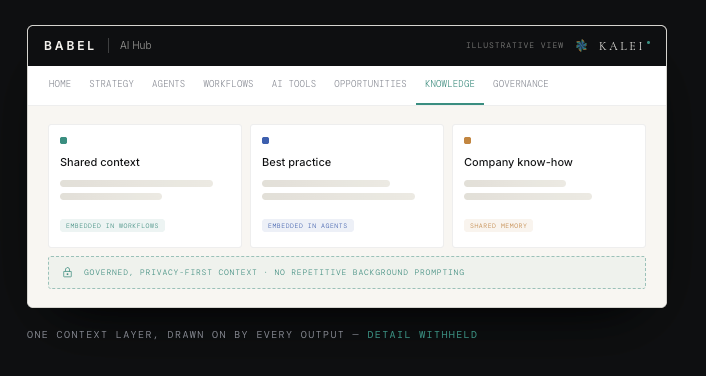
Inna: People were using AI, but it lived in individual workflows. A few people were experimenting, saving prompts in a Word document and sharing them ad hoc if someone asked. What was missing was the layer around it. No shared context, no shared standard, no shared memory. So value was being captured individually and never translated into company value or new ways of working.
Closing that gap is really two things. The first is a structured onboarding to the Kalei platform. That part looks like a traditional AI consulting process: strategy, value drivers, mapping the key workflows, redesign and build, governance, adoption. The difference is what you’re left with. Instead of static documents or one-off designed agents, you get a platform where those elements are codified and working together as a system. Context embedded into the workflows and agents. Governance and design principles built into the human-to-AI handovers. Strategy showing up as the prioritised processes that drive value, measured against a baseline.
The second is keeping it current. None of those elements is static. The technology moves, the market moves, the team’s AI maturity grows, priorities shift. So the platform and everything inside it has to be maintained, not just installed.
SR: With AI, you can technically ask it to do almost anything. Is there something you deliberately told the team not to hand to it, even though it was technically possible?
Inna: That was a design principle from the start, not an afterthought. Babel is a PR and marketing agency in the technology space, and it’s very important for them to preserve human creativity; otherwise, the outputs become robotic and synthetic. The principle we landed on was that AI helps with the ingredients, but the person still cooks the dish.
When we built the research workflow feeding into client proposals, the first version automated the research step in a way that over-prescribed the downstream output it left too little space for human creativity when people were coming up with ideas for a client. We had to go back and redesign that first step so the output doesn’t lead the process and keeps that space open. It was a very deliberate, very nuanced AI-human handover.
SR: How’s it gone since?
Inna: Really positive. One of the prioritised workflows, proposal writing, went from one to two weeks to one to two days, and that time has gone back into creative thinking, which is showing up in new business wins. And it’s ongoing. Babel are subscribers to the platform now, not a one-off strategy project.
SR: You’ve said the context layer is the part that’s actually ownable. What does that mean in practice, and where does it go next?
Inna: The models will keep commoditising. What doesn’t is an organisation’s own context, its know-how, its best practice, the judgement that usually lives in a few people’s heads. That’s the layer we curate with a client, not for them, and that’s precisely why it’s defensible. It can’t be bought in, and it can’t be pre-built by us or anyone else.
What can be built ahead is the layer underneath it. Right now the system draws on what an agency knows about itself and its clients. The next layer is proprietary market context, going deeper into a vertical so the platform brings a live view of the sectors those clients operate in, not just internal knowledge. That’s what we’re building at Kalei, and it travels between clients. Their own context never does.
Practically, it means onboarding gets faster. The next Kalei client arrives to find proven, up-to-date industry skeletons and codified expertise already in the platform, with a structured way of ingesting the relevant company’s inputs. It’s also a new form of a traditional consulting model, where the industry specialist walked in already knowing the sector, except the knowledge is codified and updated in the system rather than in one person’s head.
On AI for Leaders
SR: Alongside Kalei’s enterprise product, you launched AI for Leaders — two products for two different buyers. Why both, rather than picking one?
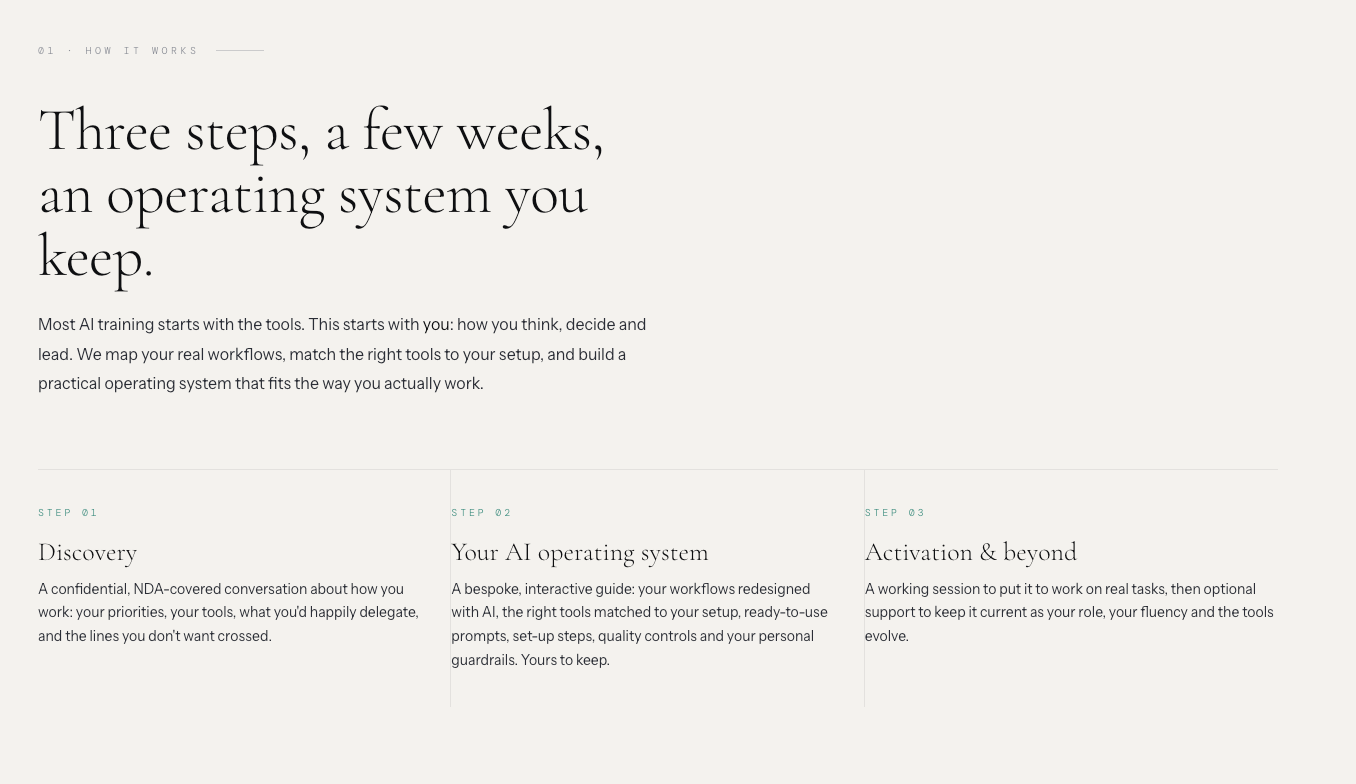
Inna: I don’t actually see them as two separate products. The substance is the same process, aimed at an individual instead of a company — discovery, human / AI triage, then tech match, then activation and adoption. And I believe successful AI transformation needs leaders who understand how AI works from hands-on experience: they’re better informed, at a strategic level, about what it means for their business. So it’s one product personalised for an individual, ideally senior, and one for the whole company, with a high correlation between the two.
SR: What do leaders typically get wrong about their own AI use — something that never shows up at the level of the whole company?
Inna: It’s calibrating agency: what you can delegate to AI, what should stay human, where trust should or shouldn’t sit. The more you use AI, the more you fine-tune that relationship, because you understand the quality of the output, you can challenge it, you know how to personalise it. What I’ve seen in practice: sometimes there’s a defensive position: “I know better than AI, so I’m not going to use it, the outputs are too generic.” And I’ve seen the flip side: over-reliance, where the output is good enough that someone bases a real decision on it without checking. I think calibrating that relationship is critical.
On the company itself
SR: Is it just you building Kalei right now, or is there a team forming? Bootstrapping, or looking to raise?
Inna: Right now, and this is a conscious choice by design: it’s me working with brilliant specialists including a tech lead, collaborating with product and industry people, people who help with client work. That shape is deliberate. Once the product is ready to scale, that’s the point where I plan to expand — potentially raise, bring people on full time. I have those stages planned for the next few months.
On Ukraine
SR: You volunteered through Deloitte, supporting Ukrainian tech professionals arriving in the UK. What did you find in those conversations — what does someone actually need, beyond a CV rewrite, to land somewhere new?
Inna: I focused on intercultural communication. I helped people understand the professional culture of the UK, which, like every country, has very particular semantics you need to be aware of in order for people to understand what you’re saying. I wanted people to walk away with the tools to translate their strengths and calibrate ways of working without feeling defensive.
I also shared my personal cultural journey, which continues: the mistakes I learned from, the strategies that worked, and the evolution of my mindset along the way. For most people I spoke to, moving cultures wasn’t their choice, but a matter of survival, so I tried to support them and share what I’ve learned, adapted to their circumstances.
On the founder’s actual week
SR: What does an actual week look like right now? Where does the founder job eat into everything else, and where have you had to say no?
Inna: I’m very strategic with my time now; the day is structured around when I’m the most productive: every morning is for deep, cognitively heavy work — product, agent development, or a thought piece I need to write. I find it extremely important to block time for deep thinking and real work, and to navigate between interconnected strategic and operational levels.
Client delivery runs alongside that continuously. I’ve set aside time for calls, networking, and meetings. And I deliberately prioritise sport, health and family. What I say no to now is absorbing as much information as I used to — I’m quite strategic about what I read, how, and when, so I don’t lose too much time to the avalanche of information around AI transformation.
SR: What’s something you’re genuinely still unsure about — with Kalei, or this path — that you don’t usually say out loud?
Inna: The honest answer is scale. I am in the process of understanding how much of this is genuinely horizontal across industry. What has to stay bespoke to a client, and what’s common enough across an industry that you build it once and carry it. I have a working hypothesis we are currently testing, not an answer.
The constraints pull against each other. IP protection. Not commoditising the work. Not letting every onboarding turn into a one-off bespoke engagement, which is precisely what I set out to avoid. Push too far one way, and you’re back to consulting. Too far the other way and you’ve built something generic that doesn’t hold the value.
But it’s the part I find most interesting, not the part that worries me. You’re twisting a Rubik’s Cube, trying to make it work for the industry and for the human at the same time. I’d rather be on that problem than one that’s already solved.
On where this goes
SR: If Kalei works exactly as you hope, what does a client’s Monday morning look like in three years that it doesn’t today?
Inna: They open Kalei, say what they want to work on, and the right context is already there: at a company, market and client level; current, curated, not reconstructed each time. It runs the workflow in a way that’s nuanced to how that firm actually works, anchored in their strategy and priorities, with the space for human creativity kept open by design.
Technologically, much of this is already possible, and it will become more so. The big labs are doing a great job of enabling it. But horizontal is the only shape that works for them, and it has to be. A consultancy will go deep into a vertical, then rebuild it from scratch for the next client, and the fee reflects that. Kalei sits between the two. The nuance a specific vertical requires, curated and current, and kept vendor-agnostic.
And Kalei’s ambition is to keep the structure current. The Monday morning three years from now isn’t running the system we built on day one. Every use tells you something. What worked, what got edited, where the handover was wrong. That goes back in, so the system sharpens with use instead of drifting. So whatever the market looks like by then, Kalei’s clients are still competitive in it.
Quick fire
Coffee or tea? Coffee — black, no sugar, fresh ground.
Fiction or non-fiction? Fiction now. I used to read a lot of non-fiction, mostly to improve myself. I still read it to understand other people’s perspectives, but often it’s someone else’s insight, already synthesised. Fiction gives you the stories, and you form your own. Currently finishing The Correspondent by Virginia Evans. Before that, Homer’s Odyssey and Voltaire’s Candide, so quite a spectrum.
City or countryside? Used to be mainly city. Now, fifty-fifty.
Which app do you use the most? Notion. It’s where thoughts, ideas and plans get written down first.
Best productivity trick — no AI involved? Every Monday morning, set the top three to five priorities for the week where I need to show progress. Prioritising is what sits with me, then I decide what part I delegate to AI agents to help execute.
Something — a book, film, experience — that changed how you see things? The Creative Act: A Way of Being by Rick Rubin. It’s adjacent to my interest in anthropology – another way of experiencing the world through creativity, observing yourself in it, noticing things. I apply that both professionally and personally.
One thing you’d want people to know, even if I hadn’t asked?
The world is changing, and what it means to be human in it is changing with it. I’d want people to look at their own work. Not whether AI is coming for their industry- that’s already been written about endlessly- but what it actually means for them.
There’s no shortage of thought pieces and forecasts for every sector. I think they’re worth reading through, but no thought piece knows your nuance. It doesn’t know what you’re actually good at, what your aspirations and dreams are, or where your judgement and creativity matter most. And now I feel it is the right time for such self-reflection.
What would you wish for our readers?
That people find a way to keep creating value, and keep the purpose in what they do, as the world changes around them.
Kalei is based in London.
Sasha Komarevych conducted this interview for StartupReporter.eu. AI tools helped transcribe, structure, and edit the raw conversation into this Q&A format; the interviewees reviewed and approved the final text before publication.
0 comments