Three Belgian founders with two exits between them launch Holmes — €1.1M pre-seed to automate software testing in the AI era
According to Google CEO Sundar Pichai, 75% of all new code at Google today is AI-generated. Across the software industry, development speed has accelerated dramatically — and quality assurance hasn’t kept up. Tests still need to be written manually, maintained continuously, and owned by someone. In fast-growing startups, that someone is usually whoever has a spare moment.
Three Belgian founders who have lived this problem firsthand have built a solution. Holmes, an autonomous QA platform launching from Ghent, has raised €1.1 million in pre-seed funding to automate software testing end-to-end — learning how a product works, continuously generating and updating tests, and catching bugs before they reach users.
The round was led by Syndicate One, with participation from Roeland Delrue and Willem Delbare (co-founders of Aikido), Louis Jonckheere (co-founder of Showpad), Thomas Van Overbeke, NewSchool, RDY Capital, and 100IN.
The problem: AI writes code faster than humans can test it
AI tools like Claude and Codex have fundamentally changed the pace at which software is built. What used to take days now takes hours. But the testing layer — the part that ensures what was built actually works for real users — has not kept pace. Most software teams still rely on manually written test scripts that need to be updated every time the product changes.
“Code today is written faster than ever, often with the help of AI. But whether the product actually works the way users expect is a different story,” says Robin Praet, co-founder of Holmes. “Holmes covers that exact gap: not whether the code is right, but whether the product holds up in real use.”
The result is a structural choice most teams are making implicitly: give up the speed AI gave them, or let bugs slip through. Holmes is built to eliminate that tradeoff.
How Holmes works: explore like a user, not a script
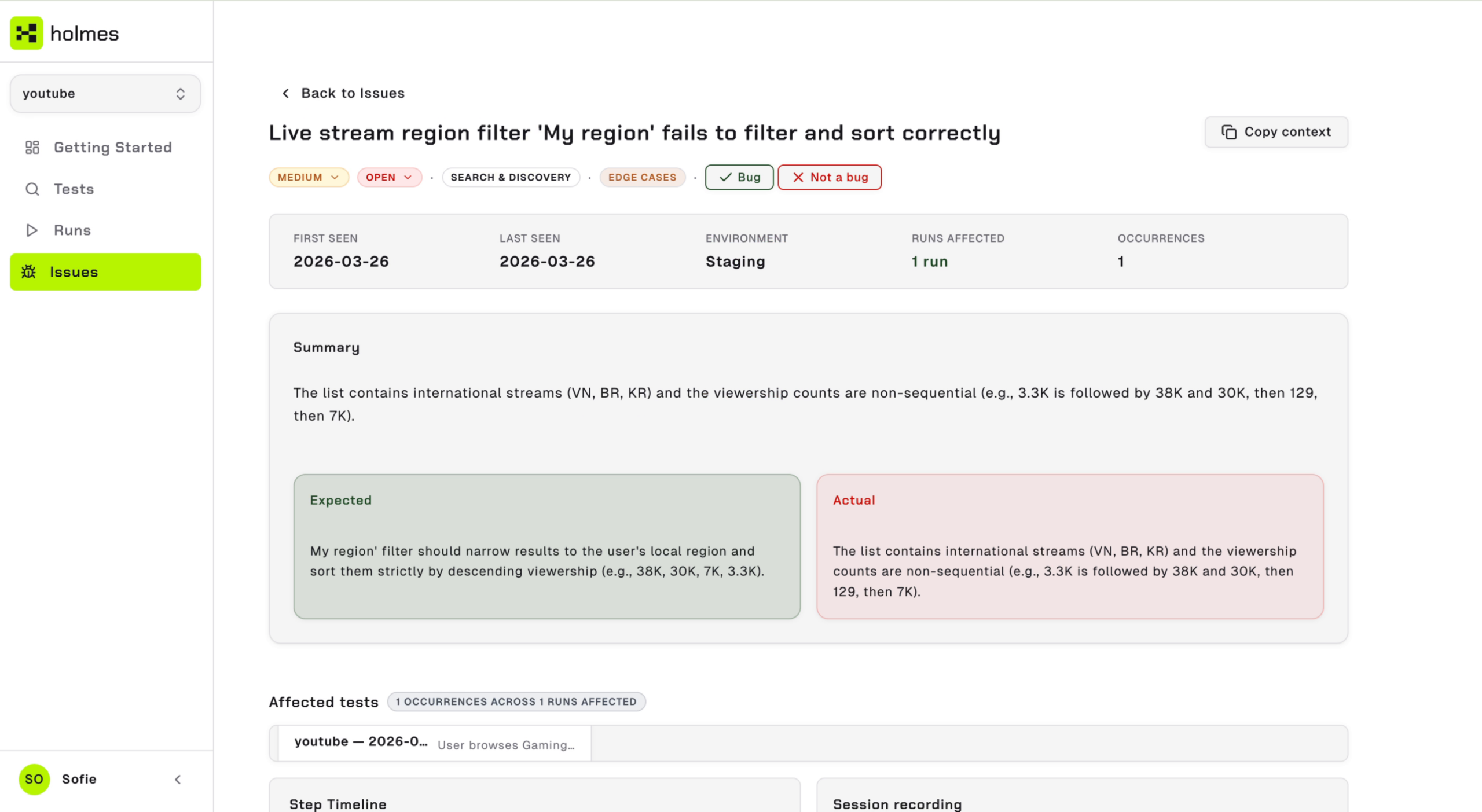
Traditional QA tools follow predefined scripts — which means someone has to write and maintain those scripts, and when the product changes, the scripts break. Holmes takes a fundamentally different approach.
Point Holmes at your app. It crawls the product and builds a map of how everything connects — no configuration required.
AI agents navigate your product autonomously, testing happy paths, edge cases, and the flows where your AI features actually run.
Holmes reproduces each issue step by step, with screenshots and video proof. No noise, no false positives — just problems worth fixing.
Issues drop straight into GitHub, Linear, or Slack the moment they happen. No new tools, no new workflows.
“Traditional tools follow scripts. Holmes explores your product like a user and tests everything continuously.”
— Holmes
Three founders, two exits, one shared problem

Sofie Buyse’s account of building at Henchman is the clearest articulation of why Holmes exists: “At Henchman, I ran into it myself: QA is work everybody knows is critical, but nobody wants to own. Skilled QA testers are hard to find and expensive to hire, so testing usually falls on product managers and developers, on top of everything else they’re already doing. And when they lose focus for even a moment, those bugs end up in front of users. That’s why we built Holmes.”
Robbrecht adds the commercial frame: “No software company builds a large QA team from day one. But every company eventually reaches the moment when manual testing starts holding back their growth. That’s the moment we built Holmes for.”
A strong Belgian ecosystem bet
The investor lineup reflects the density of Ghent’s B2B SaaS ecosystem — the same city that produced Aikido, Henchman, and Showpad. Syndicate One led the round. The Aikido co-founders and Showpad’s Louis Jonckheere participated directly, as did NewSchool.vc — which also backed Exhibitly — reinforcing Ghent’s growing reputation as Belgium’s most concentrated startup cluster.
The advisory network adds further weight: Dieter Wachters (Senior Director of Engineering, Collibra), Haroen Vermylen (co-founder and CTO, Luzmo), Jaap Vergote (co-founder, Upsellplus), and Ivo Minjauw (CPO, Lighthouse).
Holmes is currently working with 30 design partners actively shaping the product, with broader access rolling out in the coming months.
Holmes is based in Ghent, Belgium. More information at useholmes.com.
Related articles: Ghent’s Exhibitly raises €1.4M to personalise B2B event websites — 114 events signed in nine months | Tekst Raises €11.5M Series A Led by US VC Elephant — Belgian AI Tackles Enterprise Process Intelligence | Predikt Secures €750,000 to Enhance AI-Powered Financial Forecasting
0 comments