From Refugee to Builder: How Sohrab Hosseini Is Solving the Problem No One Wants to Talk About in AI
The co-founder of Orq.ai went bankrupt at 23, rebuilt himself through McKinsey and a string of operator roles, and then bet his next chapter on the unglamorous truth about generative AI: most companies can demo it. Almost none can keep it running.
Sohrab Hosseini was five years old when his family left Iran and crossed into the Netherlands, sneaking through the German border as part of the final leg of a journey that would define everything that followed. He grew up in Rotterdam, studied computer science, and — without fully understanding what he was doing — built his first company from his parents’ attic before finishing his first year of university. It was acquired nine months later.
By 22, he was running his third startup. By 23, he was bankrupt.
It was 2008. The financial crisis had cascaded from global LPs down to his investors, and the funding commitments collapsed overnight. He found himself fielding lawyers and bankruptcy proceedings with no money and no manual to follow. “That was the lowest low,” he says, without drama. “In perspective, there are many worse things that could happen in life.”
But from that low came the long climb that would eventually lead to Orq.ai — an Amsterdam-based AI infrastructure company that has raised €7.3 million in total and was recognised by Gartner in three separate Emerging Market Quadrants in 2025. The company sits at an unsexy but critical point in the generative AI stack: not building models, but ensuring the ones companies already use actually work reliably in production at scale, within a regulatory environment that is tightening fast.
We sat down with Sohrab on a Saturday morning — him in Amsterdam, grey and windy as always, this writer in Milan — to talk about the journey behind the company, the things founders don’t want to hear, and what it actually means to build in Europe right now.

Building Before You Know What You’re Doing
Sasha: Before we get into Orq.ai — where did you grow up, and was there any early signal that you’d end up building things?
Sohrab Hosseini: I was born in Iran. And moved to Rotterdam, the Netherlands, when I was five — typical refugee story. I studied computer science, but already in my first year, I was like, I’m learning all this theory, and I’m not applying it anywhere. So that’s where I, without really knowing what I was doing, built my first company. In my parents’ attic, upstairs. That one got acquired after nine, ten months by a big publisher — it was a kind of first form of social media, funny enough, before Facebook. With that, I started my second company. That one was acquired after a year by a group of VCs. So I was 22, 23, working at my third company. Then 2008 hit. The financial crisis cascaded onto us — the LPs of our VCs ran into liquidity problems, the funding commitments collapsed, and overnight we ran out of oxygen. That was a bankruptcy. I was 23, dealing with lawyers and all of that. The lowest low in my life.
Sasha: How did you rebuild from that?
Sohrab Hosseini: I worked myself out of it by joining other startups as the second guy — COO, CTO functions. And because I’d never finished my master’s — I’d been too busy running companies — and having a migrant mother who doesn’t see you as anything without a proper degree… the hard lessons from the bankruptcy made me do my executive MBA. Learn the business basics properly, next to the technical ones. And right out of the MBA, I got recruited into McKinsey. At McKinsey, I built technology platforms within large enterprises — leading programs where thousands of engineers needed shared platforms to work in a unified way. That laid the groundwork, fifteen years later, for what we’re building now.
The Co-Founder Relationship
Sasha: You co-founded Orq.ai with Anthony Diaz. How did that relationship start?
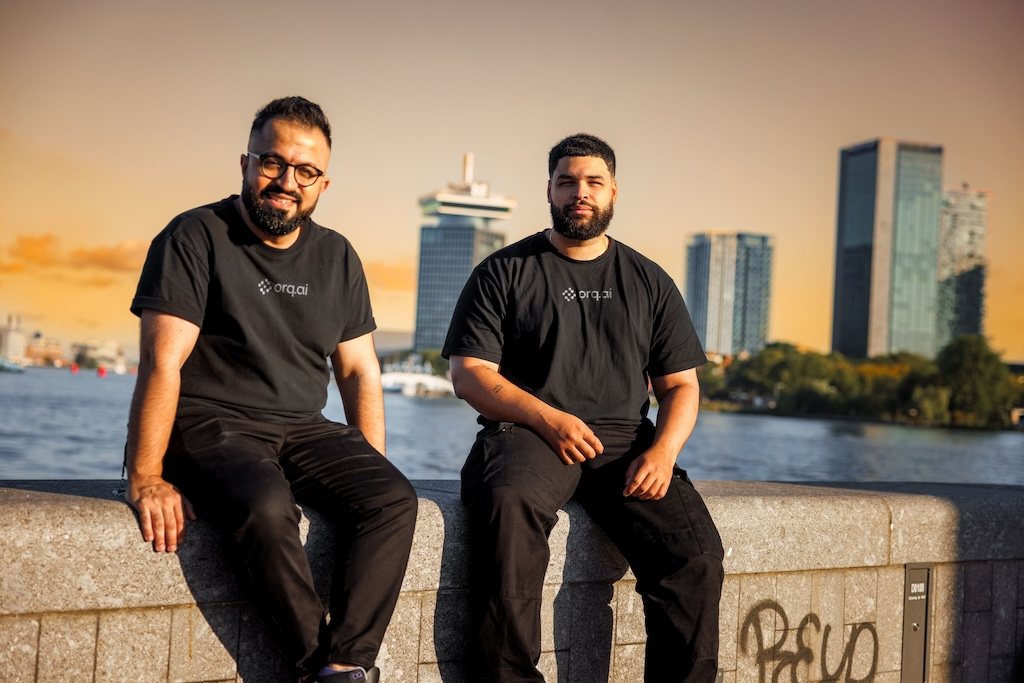
Sohrab Hosseini: I actually recruited Tony. At the company I was at between McKinsey and founding Orq, I was COO and CTO — I hired Tony as the innovation team’s lead. He moved from Spain to Amsterdam. He was always tinkering, always on the latest things — the kind of guy you give some loose screws and stuff to, and he makes something beautiful. When I decided to leave that company, I told Tony first. And within a month of me leaving, he’d also resigned. We had a Sunday brunch in Amsterdam, and he said, “Remember this component we were building?” It was a business rules management thing, nothing very special, but every SaaS company kind of needs it. I’m thinking we do something with that. I said: Okay, fuck it, let’s start.
Sasha: And it grew from there into Orq.ai?
Sohrab Hosseini: Gradually. I was doing freelance strategy work, and Tony started freelancing as a tech lead. Literally at this dining room table, we started building our first MVPs in the evenings. And then the GenAI boom came, moving so fast — it’s still moving so fast — and we had to figure out how this idea fit into that world. We’ve been running with it since. One thing that really helped: we’d worked together for a year before founding, so you know someone. You know they’re not going to have crazy attitudes or start blame games.
The pre-seed stage is when most founder pairs break up — one works harder, the other wants to be home at five; tensions build. But we already knew each other’s work ethic. Now we’re four years in. We haven’t had one fight. We debate and argue about topics — other people would hear us and think these guys are fighting. But then it clicks, and we’re sending each other funny Instagram videos as if nothing happened. Not everyone can work that way. For us, it just works perfectly.
The Hollywood Myth of Founding
Sasha: You advise early-stage AI founders alongside running Orq.ai. What mistake do you keep seeing — the one that makes you want to reach across the table?
Sohrab Hosseini: Even I am sometimes guilty of it. But it’s thinking: if I just hire the next person, all my problems will be gone. This sales guy, this technical hire. Always hoping a unicorn walks in and solves everything. And beyond that, a lot of people fool themselves. They have this romanticised, glorified Hollywood view of what founding actually is. Oh yeah, we work hard for two weeks, we do a hackathon, and then we all become billionaires in the next Apple.
They don’t understand you’re signing up for years and years of pain, of delayed satisfaction, with a one per cent chance that it actually works. You have to be, at some level, a bit crazy. A lot of people sign up for an accelerator batch, and six months later, they’re going freelance again. The selection bias of Steve Jobs and Bill Gates is genuinely dangerous for the ecosystem.
Raising: The Invisible Grind
Sasha: You’ve raised three rounds over roughly two years. What’s the reality that people don’t see?
Sohrab Hosseini: For the last round, I spoke to 190 funds. Then some of those went to the second and third meetings. That sucks up a lot of time. And because we’re in a hot space, everyone wants to talk to you — even just for their own education. So it’s hard to filter out the people who are sucking information out of you but aren’t actually interested. A lot of nos. Not ‘this will never work’ nos, but the typical VC answer: we want to see more traction, more proof points. You learn to discount that to zero and move on. You have to kiss a lot of frogs.
Sasha: Where should European founders focus their fundraising energy?
Sohrab Hosseini: UK first, then Germany, then France. Most VCs in other European countries are too conservative, too small-thinking — more like bankers than investors. In a lot of these places, it’s genuinely easier to get a mortgage than VC funding. The Netherlands and Belgium — they say they do pre-seed, put it on their websites, but they don’t actually do it.
They’re former bankers who want to see more traction before taking any risk. That’s why the US is winning. Every million euros of VC funding in Europe is five million in the US. Not because they have smarter people — many great founders in the US are Europeans who moved there. We need to be honest about that.
Building in Europe: An Honest Assessment
Sasha: You’re building from Amsterdam. What does that give you — and what does it cost you?
Sohrab Hosseini: The Netherlands has always been good for me personally. They gave us a home when we didn’t have one, and I owe them that. But as an ecosystem, it’s not good — let’s be honest. The government intervenes too much, creating chaos, whether through taxes, laws, or even by subsidising competitors. And culturally, after eight comfortable years in Europe, there are a lot of soft, weak people. No grit, no grind. They don’t hype each other up.
The ecosystem is not big enough — you always see the same fifteen founders everywhere. We had actually done all the paperwork to move to San Francisco. But then the geopolitical situation shifted with Trump and all the AI sovereignty movement, and suddenly, being the European company building European AI infrastructure is our strongest card. So we’re holding that position for now. But if I were to do it all over again, I wouldn’t set up shop in Amsterdam. I love living here. The quality of life is great. But as an entrepreneurial ecosystem, there’s a lot of work to do.
The Product Vision: HR for the Invisible Workforce
Sasha: What does Orq.ai look like in three to five years if everything goes right?
Sohrab Hosseini: We will be the HR department for AI agents. Just like you have an HR department with processes and policies — hiring employees, onboarding, training, offboarding — you need to do that for your agents. The invisible workforce. You’re going to have tens, if not hundreds, of agents running around in your company. They’re touching your databases, updating your data.
They’re not coming from one vendor — every vendor is adding agents into their product: SAP, Salesforce, and so on. You’re going to lose track. There will be huge fragmentation. And we become the layer that enables you to manage the digital twin of your organisation — compliance, governance, control, agent lifecycle management, onboarding, and offboarding. That’s where this is going.
What Actually Shapes a Founder
Sasha: A book, film, or experience that genuinely changed how you see things — not the polished answer, the real one.
Sohrab Hosseini: Nelson Mandela’s Long Walk to Freedom. I was just on Robben Island in Cape Town three weeks ago. For twenty-seven years, in the harshest conditions, he remained positive, not taking revenge and bringing a whole, broken country together. That requires a backbone we just don’t see in current leaders. But as a personal reference point: when you’re in a dark place, you think — if that man could do it for twenty-seven years carrying bricks in that heat, what am I complaining about? That’s my recalibration tool.
Sasha: And experiences that shaped you personally — the crossroads?
Sohrab Hosseini: There are a couple of big ones. Leaving Iran — I was five, and I still have the image of walking through the airport and the family standing behind the glass. Crossing the German border on foot as part of the trip to the Netherlands, because there were no open borders, and we had to sneak through. Then the bankruptcy at 23 — a year of hell with lawyers and processes I had no idea how to navigate. Those are the chapters that really shaped me.
Sasha: What do you think investors have seen in your background that gave them confidence?
Sohrab Hosseini: I’m sure the battle scars help. With a founding team that includes an Iranian and a Cuban refugee, they’ll probably work a bit harder than someone who grew up in very comfortable circumstances. But beyond that, I think it’s that we’re very open and transparent. I have a big mouth, and I don’t play politics or theatre. What you see is what you get. People can put their guards down and actually talk about real things instead of sniffing each other to figure out what’s behind the mask. Life’s too short for that.
Quick Fire questions
- Coffee or tea? Coffee in the morning, tea in the evening.
- Dogs or cats? Dogs.
- Summer or winter? Summer.
- Fiction or non-fiction? Non-fiction.
- Sweet or savoury? Sweet.
- City or countryside? City.
- Comedy or drama? Both — it’s more about quality than the type.
- Which app do you use the most? Right now, X — I’m following the war in Iran and my neck is probably destroyed from scrolling. Normally, it would be LinkedIn.
- Favourite productivity trick? Keep a prioritised backlog at all times. I have so many signals coming in that I’d lose track without it. It’s my source of truth so I don’t have to rely on my brain.
- What would you wish our readers? Uncomfortable growth.
—
Orq.ai is headquartered in Amsterdam and has raised €7.3M in total funding. The company was recognised by Gartner in three Emerging Market Quadrants in 2025 and currently employs 25 people. For more information, visit orq.ai.
Related articles: Orq.ai Spins Out Its AI Router as Standalone Product After Watching Customers Build — Then Abandon — Their Own | Scaling Success: An In-Depth Interview with Anton Volovyk, Co-CEO of Reface | Scavenger AI Raises €2.5M to Help Europe’s SMEs Talk to Their Data
0 comments